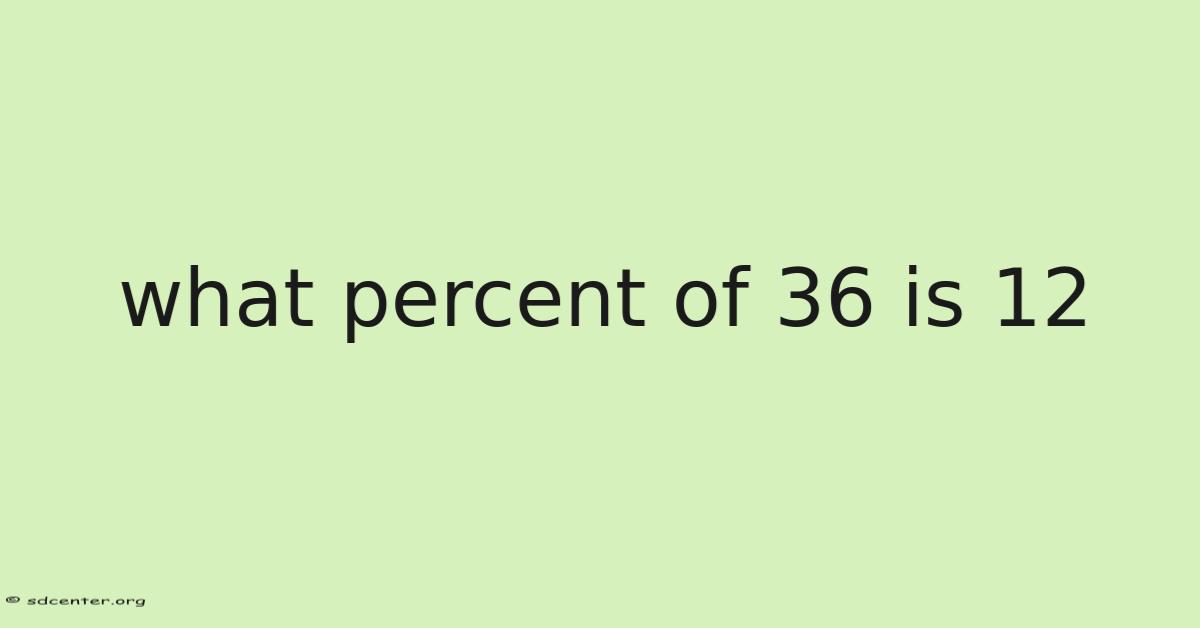
So you're staring at a math problem and wondering, "What percent of 36 is 12?" Maybe it popped up on a worksheet, or you're trying to figure out a discount at the store. Whatever the reason, this is one of those questions that seems simple but trips people up more than you'd expect.
The short answer is 33.33%. But here's what most people miss — it's not just about getting the number. It's about understanding what the question is actually asking and why it matters in real life.
Let's break this down properly.
What Is "What Percent of 36 is 12" Actually Asking
This isn't a trick question. Still, it's asking: if 36 represents the whole (or 100%), what portion of that whole is 12? Put another way, 12 is what percentage of 36?
You could write this as a fraction: 12 over 36. Then you convert that fraction to a percentage. Simple enough, right?
But here's the thing — most people rush through this and make the same basic mistakes every time.
The Fraction Behind the Question
When you see "what percent of 36 is 12," think of it as a fraction: 12/36. That's why the top number (12) is the part you're looking at. The bottom number (36) is the whole or total amount.
To find the percentage, you divide the part by the whole. So 12 divided by 36 equals... 0.3333...
Converting to Percentage
Once you have your decimal (0.), you multiply by 100 to get the percentage. And that gives you 33. In practice, 3333... 33%.
Or, if you want to think of it another way: 12 is one-third of 36, and one-third as a percentage is 33.33%.
Why This Matters More Than You Think
Okay, so you got 33.33%. But why should you care? This isn't just some abstract math problem — it's a fundamental skill that pops up everywhere.
Shopping and Sales
Ever seen a sign that says "30% off" and wondered if that's actually a good deal? You're already doing this calculation in your head. If something costs $50 and it's 30% off, you multiply 50 by 0.30 to find the discount amount.
But reverse it too. Day to day, if a shirt is marked down from $36 to $24, what percent discount is that? You'd figure out it's a 33.33% discount — same math, different direction.
Business and Finance
Professionals use this calculation constantly. Profit margins, growth rates, market share — they all rely on understanding percentages of totals. That said, if your company made $12 million in profit out of $36 million in revenue, your profit margin is 33. 33%.
Data Analysis
When you read that "12 out of 36 respondents preferred option A," that's 33.33% of the sample. Understanding this helps you make sense of polls, surveys, and research findings.
How to Calculate Percent of a Number (Step by Step)
Let's get practical. Here's how to tackle "what percent of X is Y" questions in general.
Step 1: Set Up Your Fraction
Write down the part over the whole. In our example: 12/36.
Step 2: Divide
Take the part (12) and divide it by the whole (36). You can do this on a calculator or by hand.
12 ÷ 36 = 0.3333...
Step 3: Convert to Percentage
Multiply your decimal by 100:
0.3333... × 100 = 33.33%
That's it. Three steps, and you've got your answer.
Working With Decimals and Rounding
In practice, you'll often be dealing with decimals that go on forever. 1/3 equals 0.On top of that, 3333... And repeating infinitely. Most of the time, you'll round to two decimal places, giving you 33.33%.
But sometimes you need more precision, or you're working with different numbers entirely. The process stays the same.
Common Mistakes People Make
Here's where it gets interesting. People mess this up in predictable ways, and knowing what those mistakes look like can save you a lot of headaches.
Mistake #1: Flipping the Numbers
Some people divide 36 by 12 instead of 12 by 36. So that gives you 3, which is obviously wrong. You're asking "what percentage is 12 of 36," so 12 has to be the numerator.
Mistake #2: Forgetting to Multiply by 100
I've seen students divide 12 by 36, get 0.They forget that percentage means "per hundred.3333, and stop there. " You have to multiply by 100 to convert the decimal to a percentage.
Mistake #3: Rounding Too Early
If you're working with a calculator, round only at the very end. If you round 0.3333 to 0.33 before multiplying by 100, you'll get 33% instead of 33.In real terms, 33%. That missing decimal place might not matter for a homework problem, but in finance or science, it could be significant.
Continue exploring with our guides on ap physics 1 exam score calculator and what percent of 160 is 56.
Mistake #4: Not Understanding What the Question Is Asking
This is the big one. People see "percent" and immediately think they need to multiply something by 0.Worth adding: 01. But "what percent of 36 is 12" is asking you to find the relationship between 12 and 36, not to do any multiplication at the start.
Practical Tips That Actually Work
Let's talk about what works in real situations, not just textbook problems.
Tip #1: Use Mental Math Shortcuts
For simple fractions, memorize common conversions:
- 1/2 = 50%
- 1/3 = 33.33%
- 1/4 = 25%
- 1/5 = 20%
Since 12 is one-third of 36, you already know it's 33.33%. No calculation needed.
Tip #2: Cross-Multiply When Setting Up Proportions
If you prefer working with proportions, set it up like this:
12/36 = x/100
Cross-multiply: 12 × 100 = 36 × x 1200 = 36x x = 1200 ÷ 36 x = 33.33%
Same answer, different method.
Tip #3: Check Your Work by Going Backwards
Take your percentage and apply it to the original number. If 33.So naturally, 33% of 36 is 12, then 0. 3333 × 36 should equal 12. Which means quick check: 0. 3333 × 36 = 11.9988, which rounds to 12. Good!
Tip #4: Use the Percentage Formula
The general formula for finding percentage is:
Percentage = (Part/Whole) × 100
Memorize this, and you can handle any "what percent of" question.
Frequently Asked Questions
How do you find the percentage of a number?
To find what percentage one number is of another, divide the first number by the second, then multiply by 100. That's why for example, to find what percentage 12 is of 36: (12 ÷ 36) × 100 = 33. 33%.
What's the easiest way to calculate percentages?
For simple fractions, use mental math shortcuts. Here's the thing — for more complex calculations, use the formula (part/whole) × 100, or cross-multiply with proportions. Always double-check by reversing the calculation.
Can you
Can you calculate percentages without a calculator? Plus, absolutely. Here's the thing — when the numbers are friendly—like multiples of 5, 10, or 25—you can often break the problem into simpler steps. On the flip side, for instance, to find what percent 18 is of 60, notice that both numbers are divisible by 6: 18 ÷ 6 = 3 and 60 ÷ 6 = 10, so the fraction reduces to 3/10, which is 30%. If the numbers don’t share an obvious factor, you can still use estimation: round the divisor to a nearby round number, compute the rough percentage, then adjust. For 12 of 37, rounding 37 to 40 gives (12/40)×100 = 30%; since the actual denominator is slightly smaller, the true percentage will be a bit higher—around 32.4%. This quick‑check method helps you spot gross errors before you commit to a precise calculation.
Another handy trick is to work with “per‑unit” values. Determine what 1% of the whole is by dividing the whole by 100, then multiply that unit by the part. For 12 of 36, 1% of 36 is 0.36; multiplying 0.Practically speaking, 36 by 12 yields 4. 32, which is actually 12% of 36—so you’ve inadvertently solved the inverse problem. Also, to get the correct direction, divide the part by the 1% value: 12 ÷ 0. 36 = 33.Here's the thing — 33%. This approach reinforces the idea that a percentage is simply how many “1% chunks” fit into the part.
When dealing with money, percentages often translate directly into cents or dollars, making mental math even easier. Here's the thing — a 15% tip on a $40 bill, for example, can be found by calculating 10% ($4) plus half of that ($2) for a total of $6. Applying the same logic to “what percent of” questions lets you swap the roles: if you know the tip amount and the bill, you can recover the percentage by reversing the tip‑calculation steps.
Finally, always keep the units straight. That said, the “part” and “whole” must be measured in the same units—both in dollars, both in items, both in seconds—before you divide. Mixing units (e.g., comparing minutes to hours) will produce a nonsensical percentage unless you convert first.
Wrapping Up
Mastering percentages boils down to three core habits: (1) set up the fraction correctly (part over whole), (2) remember to multiply by 100 to shift from a decimal to a per‑hundred expression, and (3) verify your answer by working backward or using an alternative method. Also, with these safeguards in place, you’ll avoid the classic pitfalls of flipped fractions, premature rounding, and forgotten scaling factors. Whether you’re balancing a budget, analyzing data, or helping a child with homework, the same simple toolkit—mental shortcuts, proportion setup, and a quick reverse‑check—will keep your percentages accurate and your confidence high.
