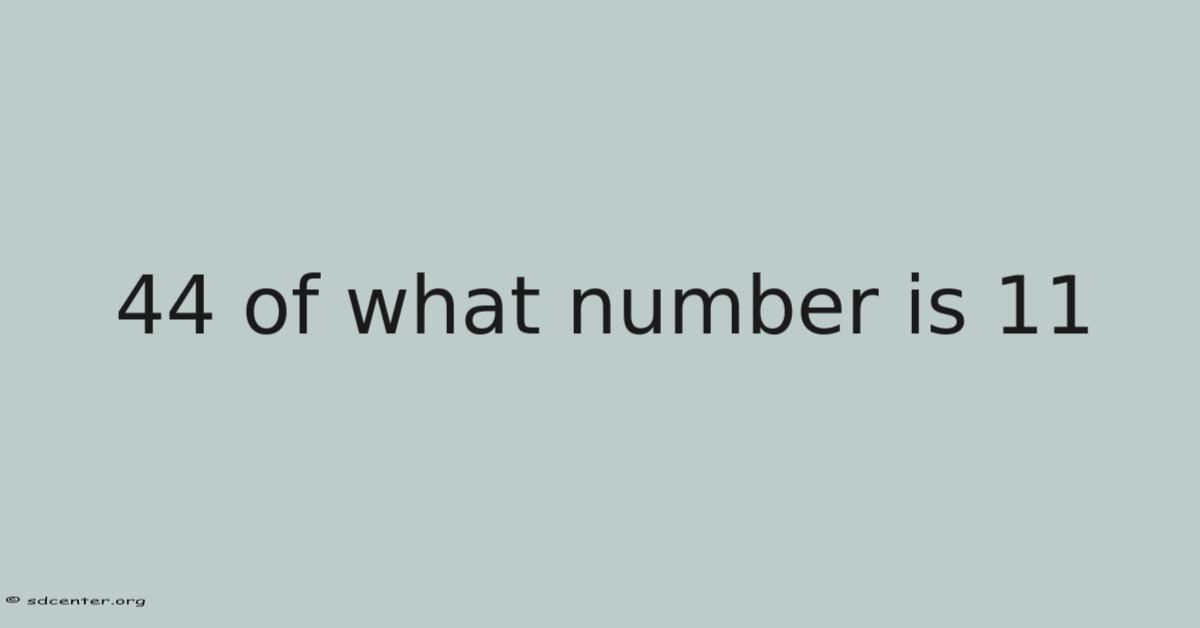
Did you ever stare at a puzzle that says “44 of what number is 11” and wonder if you’re missing something obvious? You’re not alone. That little equation pops up in everyday situations—think discount tags, test scores, or even when you’re splitting a bill. In practice, ” The truth is, it’s a tiny percentage problem wrapped in a riddle, and once you crack the code, you’ll see how useful it really is. Even so, the twist is that most people skim past it, assuming it’s either a trick or a simple “just divide. Let’s dive into why this seemingly tiny question matters and how you can solve it without breaking a sweat.
What Is 44 of what number is 11
At its core, “44 of what number is 11” is a shorthand for a percentage question. In plain language, it asks: 44% of what number equals 11? People often write it this way when they’re trying to be clever or when they’re jotting a quick note on a napkin. The phrase “of what number” signals that we’re looking for an unknown value, usually called x.
44% × x = 11
If you’ve ever taken a basic math class, you’ve seen this pattern before. It’s the same structure as “What percent of 50 is 15?On top of that, ” or “30 is 20% of what number? ”—just with a slightly different wording. The key is to recognize that “44 of what number is 11” isn’t a mysterious code; it’s simply a percentage problem in disguise. Which is the point.
Why the wording matters
The phrase “44 of what number is 11” can be confusing because it omits the word “percent.” In everyday conversation, people drop the “percent” for brevity, assuming the context makes it clear. Even so, that omission can lead to misinterpretation. Take this: someone might think “44 of what number is 11” refers to a fraction like “44/ something,” when in fact it’s a percentage. Spotting the hidden “percent” is the first step to solving the puzzle.
Real‑world examples
You’ll encounter this type of question in several scenarios:
- Shopping: A $44 item is on sale for $11. What was the original price? (Here, $11 is 25% of the original price, not 44%.)
- Grades: If you earned 44 points out of a possible 100, you got 44%. But if you earned 11 points, what was the total possible score? (Answer: 25 points.)
- Finance: A $44 investment grew by 11%. What was the initial amount? (Again, 11 is 25% of the original.)
Each of these examples uses the same underlying math, just dressed up in different contexts.
Why It Matters / Why People Care
Why should anyone care about a tiny equation that pops up in a quick puzzle? Because percentages are the lingua franca of numbers in daily life. They help us compare, budget, and make decisions without getting lost in raw figures.
- Budgeting: Knowing that $11 is 44% of your grocery budget tells you the total budget is $25. That insight helps you plan for the month.
- Sales: A $11 discount on a $44 item sounds like a great deal, but realizing that $11 is 25% of the original price can change how you view the savings.
- Health: If a lab result shows 44% of something is 11 units, you can calculate the total concentration, which matters for diagnosis.
In short, the ability to reverse‑engineer percentages protects you from being misled by marketing tactics and helps you make smarter financial choices. It’s the kind of math that feels magical when you first master it, but it’s also the kind that keeps popping up when you least expect it.
The hidden cost of misunderstanding
When people skip the step of converting percentages to decimals, they often get the answer wrong. So imagine a shopper who sees “44% off, now $11” and thinks the original price was $44. In a broader sense, misreading percentages can lead to poor investment decisions, inaccurate budgeting, and even health missteps. That mistake costs them money because they underestimate the discount. That’s why this puzzle isn’t just a brain teaser—it’s a practical skill.
If you found this helpful, you might also enjoy ap world history review for exam or difference between positive and negative feedback loops.
How It Works
Now that we know why this matters, let’s walk through the actual solving process. I’ll break it down into clear steps
Step‑by‑Step Solution
1. Identify the percentage relationship
The phrase “44 of what number is 11” is a shorthand for “44 % of some unknown number equals 11.” The word “percent” is implied, even though it isn’t written out.
2. Convert the percent to a usable form
Percent means “per hundred,” so 44 % = 44⁄100 = 0.44. Working with a decimal (or a fraction) makes the algebra straightforward.
3. Set up the equation
Let the unknown number be (x).
[
0.44 \times x = 11
]
4. Isolate the unknown
Divide both sides by 0.44 to solve for (x):
[
x = \frac{11}{0.44}
]
5. Perform the division
[
x = \frac{11}{0.44} = \frac{11 \times 100}{44} = \frac{1100}{44} = 25
]
6. Verify the result
Check by plugging 25 back into the original statement: 44 % of 25 = 0.44 × 25 = 11. The math checks out.
Quick‑Reference Formula
If you ever encounter a problem of the form “(p) % of what number is (q)?”, use:
[ \text{Whole} = \frac{q}{p/100} = \frac{100q}{p} ]
Applying the Method to Real Situations
| Context | What you know | What you need | Calculation |
|---|---|---|---|
| Shopping | $11 is 44 % of the original price | Original price | ( \frac{100 \times 11}{44} = $25 ) |
| Grading | 11 points represent 44 % of the total | Total possible points | ( \frac{100 \times 11}{44} = 25 ) points |
| Finance | $11 is 44 % of an investment’s growth | Initial amount | Same formula → $25 initial investment |
In each case, the same algebraic steps give you the missing whole, allowing you to compare values on an equal footing.
Tips to Avoid Common Pitfalls
- Never skip the conversion. Treat “44 of what number is 11” as “44 % of what number is 11” from the start.
- Watch the decimal placement. 44 % is 0.44, not 44. Mistaking the percent for the raw number is the most frequent error.
- Use proportions when you prefer fractions. Set up (\frac{44}{100} = \frac{11}{x}) and cross‑multiply; you’ll reach the same answer.
- Round only at the end. Keep full precision during calculations, then round if the context (money, grades, etc.) demands it.
Conclusion
Mastering the art of working backward from a percentage to its original whole transforms a seemingly cryptic puzzle into a reliable, repeatable process. Whether you’re deciphering a discounted price, evaluating a test score, or untangling financial data, the ability to answer “44 % of what number is 11?” equips you with a versatile tool for everyday decision‑making. By internalizing the simple formula (\text{Whole} = \frac{100 \times \text{part}}{\text{percent}}) and applying it with care, you’ll handle percentage‑based problems with confidence and avoid the costly mistakes that arise from misreading the numbers.
