Have you ever stared at a math problem for five minutes, only to realize you were overthinking something that should have been simple?
We’ve all been there. You’re looking at a discount, a tip, or a tax calculation, and suddenly the numbers start swimming. You know the answer is right there, but your brain just refuses to bridge the gap between the question and the solution.
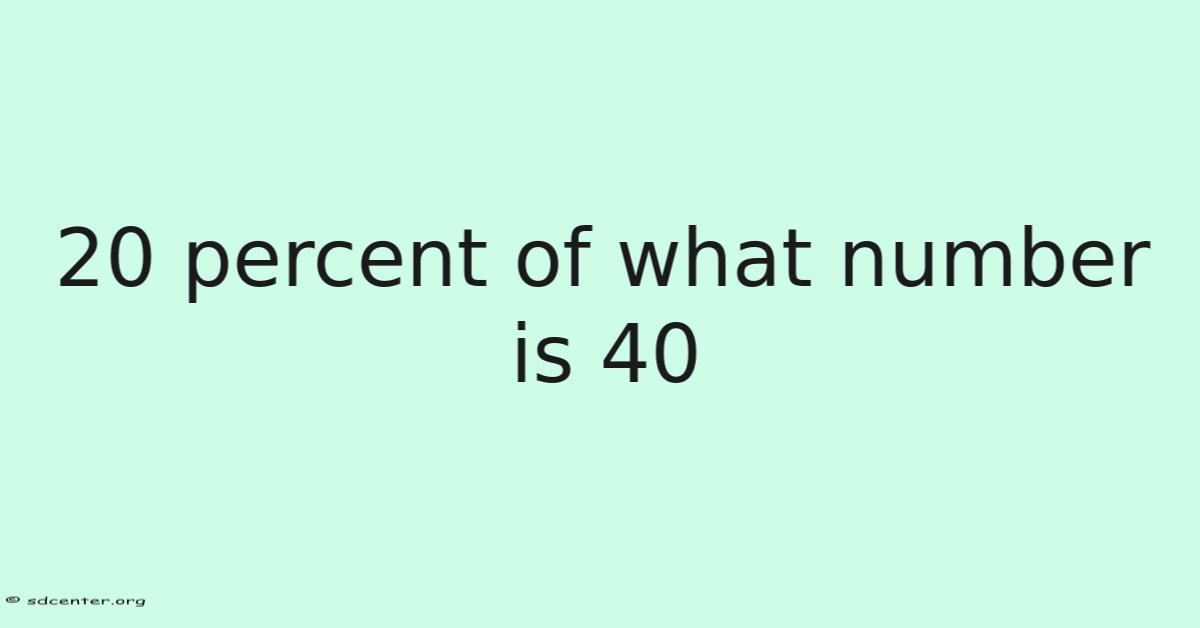
Specifically, you’re stuck on this: 20 percent of what number is 40?
It sounds like a riddle, but it’s actually just a doorway into understanding how percentages work in the real world. Once you get this down, you won't just solve this one problem—you'll stop letting numbers intimidate you.
What Is This Problem Actually Asking?
When we talk about math, we often get bogged down in the jargon. But let's strip that away.
At its core, this isn't about complex calculus or high-level algebra. It's about proportions. Think about it: when someone asks, "20 percent of what number is 40? ", they are essentially asking you to find the "whole" when you only know a "part.
Think of it like this: Imagine you have a large pizza. Because of that, you eat a few slices, and someone tells you that the slices you ate represent 20% of the entire pie. This leads to you look down and see you've eaten exactly 40 grams of pizza. Now, you want to know: how big was the whole pizza to begin with?
The Concept of the Whole
In every percentage problem, there are three players:
- The Percentage (the portion or the rate).
- The Part (the specific amount we know).
- The Whole (the total amount we are trying to find).
In this specific case, we know the percentage is 20% and the part is 40. We are missing the whole.
Percentages as Fractions
Here is the secret that most people skip: a percentage is just a fraction in disguise. "Percent" literally means "per hundred." So, 20% is just another way of saying 20 out of 100, or 2/10, or 1/5. Once you stop seeing "%" as a weird symbol and start seeing it as a ratio, the math becomes much less scary.
Why This Matters
You might be thinking, "I have a calculator on my phone, why do I need to understand the logic?"
Real talk: because calculators don't teach you how to think. They just give you answers.
Understanding the relationship between parts and wholes is vital for almost every adult task. If you're negotiating a salary, you need to know if a 5% raise is actually worth it after taxes. If you're shopping, you need to know if a "20% off" sale is actually a good deal or just marketing fluff.
When you can't mentally map out these proportions, you become vulnerable to bad math. You might overpay for a service or miscalculate a budget because you couldn't quickly figure out what the "total" was supposed to be.
How To Solve It (The Right Way)
There isn't just one way to solve this, and honestly, different methods work better depending on how your brain is wired. Some people love the rigid structure of algebra, while others prefer a quick mental shortcut.
The Algebraic Method
If you like rules and structure, this is for you. We can turn the English sentence into a mathematical equation.
The word "is" almost always means "equals" (=). The word "of" almost always means "multiplication" (x).
So, the sentence "20 percent of what number is 40" translates to: 0.20 * x = 40
Now, we just need to get x by itself. To do that, we divide both sides by 0.20: **x = 40 / 0.
When you run that math, you get 200.
The Fraction Shortcut
This is the method I use when I'm out at a restaurant or shopping and don't want to pull out my phone.
If you found this helpful, you might also enjoy ap us history test score calculator or what are the 3 parts that make up a nucleotide.
As we mentioned earlier, 20% is the same as 1/5. If 1/5 of a number is 40, then the whole number must be 5 times larger than 40.
40 * 5 = 200
It’s fast, it’s clean, and it requires zero fancy notation. If you can recognize that 25% is 1/4, or 50% is 1/2, you can solve these problems in your head in seconds.
The Ratio and Proportion Method
This is the "old school" way you probably learned in middle school. It's incredibly reliable because it works for any percentage, even the messy ones like 17.5%.
You set up two fractions that are equal to each other: 20/100 = 40/x
You then use cross-multiplication: 20 * x = 40 * 100 20x = 4000 x = 4000 / 20 x = 200
It takes a few more steps, but it’s foolproof.
Common Mistakes / What Most People Get Wrong
I've seen people struggle with this for years, and usually, it's because they fall into one of two traps.
The Multiplication Trap The most common mistake is multiplying the numbers instead of dividing them. Someone sees "20" and "40" and immediately thinks "20 times 40 is 800." But wait—if 20% of a number is 40, that number has to be larger than 40. If you get an answer that is smaller than your "part," you've gone wrong. Always do a "sanity check" on your answer.
The Decimal Error
When using the algebraic method, people often forget to convert the percentage into a decimal. They try to calculate 20 * x = 40. If you do that, you'll get 2. But 20% of 2 is definitely not 40. You have to move that decimal point two places to the left to turn 20% into 0.20. It’s a tiny mistake that ruins the whole calculation.
Practical Tips / What Actually Works
If you want to become a "math person" (and yes, you can be one), you need practical strategies, not just formulas.
- Use the "10% Rule": This is my favorite trick. To find 10% of any number, just move the decimal one spot to the left. If you know 10% of a number is 20, then 20% must be 40. This makes mental math incredibly easy.
- Always Sanity Check: Before you finalize an answer, ask: "Does this make sense?" If you're looking for 20% of a number and your answer is 200, does 40 feel like a reasonable chunk of 200? Yes. If your answer was 2,000,000, you'd know you missed a decimal point somewhere.
- Visualize the Whole: If you're stuck, draw a quick rectangle on a piece of paper. Divide it into five sections (since 20% is 1/5). Label one section "40." It becomes immediately obvious that the whole rectangle must be 200.
- Learn the "Friendly" Percentages: Don't waste time calculating 19% or 31% in your head. Round them to 20% or 30% to get a "close enough" estimate, then refine if you actually need to be precise.
FAQ
What is 20% of 40?
Don't confuse this with the original question! 20% of 40 is 8. (0.2
To find 20% of 40, multiply 40 by 0.20:
40 × 0.20 = 8.
Final Answer
The number you’re seeking is 200.
Conclusion
Understanding percentages boils down to recognizing their relationship to the whole. Whether through algebra, ratios, or mental math tricks like the 10% Rule, staying organized and sanity-checking answers prevents common pitfalls. By mastering these strategies, you’ll not only solve problems like “20% of what number is 40?” but also build confidence in tackling real-world scenarios—from calculating discounts to analyzing data. Remember: percentages are just fractions of 100, and with practice, they become second nature.
