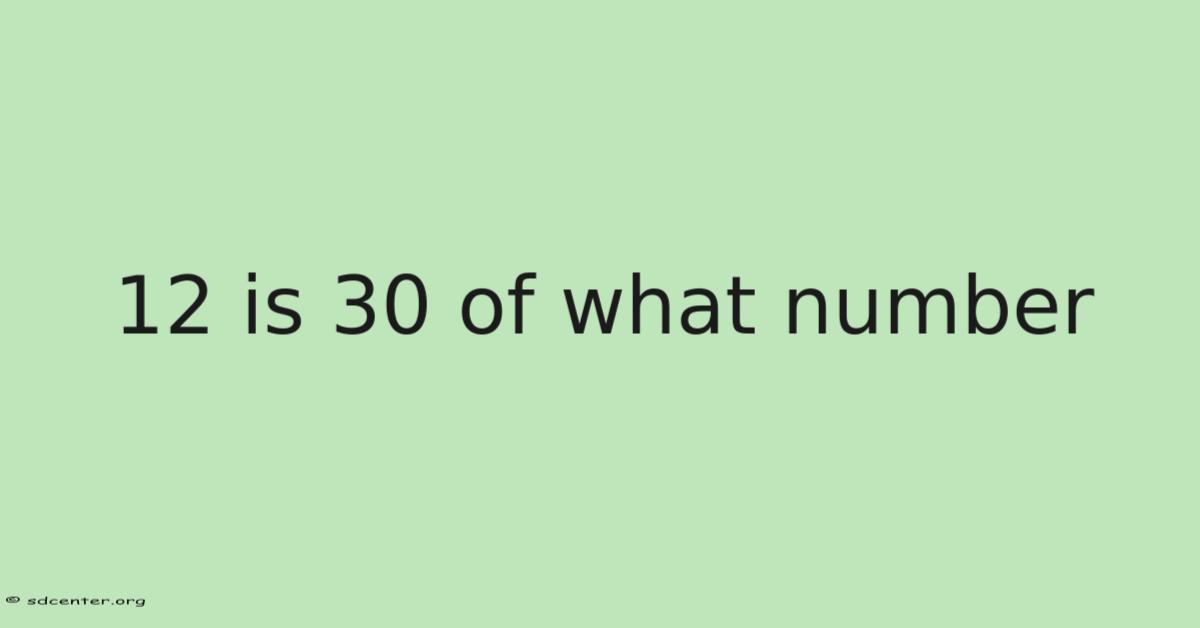
You’ve probably seen a problem that reads 12 is 30 of what number and wondered how to crack it. The good news is that the question isn’t a trick; it’s a straightforward percentage puzzle once you know the steps. And maybe you stared at a worksheet, or a quick‑fire quiz popped up on a phone, and the numbers felt like they were speaking a language you hadn’t learned yet. In this post we’ll walk through the logic, the math, and a few real‑world tricks that make similar problems feel almost automatic. By the end you’ll not only know the answer to this specific case but also feel confident tackling any “X is Y % of what number?” challenge that comes your way.
Understanding the Phrase
What Does “30 of” Actually Mean
When someone writes “30 of what number,” they’re really talking about 30 %. 30 in decimal form. So the word percent* comes from the Latin per centum*, meaning “by the hundred. Consider this: ” So 30 % is the same as 30 out of 100, or 0. It’s a compact way to say “a portion of a whole,” and it shows up everywhere—from shopping discounts to interest rates on loans.
Why Percentages Matter
Percentages let us compare parts to wholes on a common scale. Plus, if you know that a pizza slice is 12 % of the whole pie, you can instantly gauge how big that slice is relative to the entire pizza. The same idea applies when a retailer says “30 % off” or a bank advertises “2 % interest.” Grasping that relationship is the first step toward solving the equation hidden behind the words.
The Math Behind It
Step 1: Turn the Words Into an Equation
The phrase 12 is 30 of what number can be translated directly into algebra. Let’s call the unknown number x. The statement says:
12 = 30 % of x
In symbols that becomes:
12 = 0.30 × x
That’s it—just a simple equation with one unknown. Here's the thing — the trick is recognizing that “30 %” is the same as “0. 30” when you move the decimal point two places to the left.
Step 2: Solve for the Unknown
Now we isolate x. Divide both sides of the equation by 0.30:
x = 12 ÷ 0.30
Doing the division gives:
x = 40
So the answer is 40. Which means if you check your work, multiply 0. In plain English, 12 is 30 % of 40. 30 by 40 and you get back to 12—perfect.
Converting Percentages to Decimals
A quick mental shortcut: moving the decimal two spots left turns any percent into a decimal. 30 % → 0.On top of that, 30, 15 % → 0. Plus, 15, 75 % → 0. 75. Once you have the decimal, the rest is just basic arithmetic. This conversion is the backbone of most percentage problems you’ll encounter.
Real World Context
Where You’ll See This Type of Question
-
Shopping: A tag says “30 % off.” If the discounted price is $12, what was the original price?
-
**
-
Finance: A loan advertises a 2 % monthly interest rate. If the interest charged this month is $6, what was the principal balance?
-
Education: A student scored 18 points on a quiz, which represents 45 % of the total possible points. What is the quiz’s maximum score?
-
Health & Fitness: A nutrition label shows that a serving contains 8 g of protein, which is 20 % of the daily recommended amount. How many grams of protein should you aim for each day?
-
Data Analysis: A survey found that 57 respondents prefer product A, making up 19 % of the total participants. How many people were surveyed in total?
Quick‑Trick Toolbox
-
The 10 % Shortcut – Find 10 % of the unknown by moving the decimal one place left, then scale up.
Example:* To solve “12 is 30 % of what?”, first find 10 % of the answer (which is 12 ÷ 3 = 4). Since 30 % is three times 10 %, multiply 4 by 3 → 12, confirming the unknown is 40.2. Proportion Method – Set up a simple ratio:[ \frac{12}{x} = \frac{30}{100} ]
Cross‑multiply (12 × 100 = 30 × x) → 1200 = 30x → x = 40.3. Plus, Fraction‑First Approach – Convert the percent to a reduced fraction when possible. Because of that, 30 % = 3⁄10, so the equation becomes 12 = (3⁄10) × x → x = 12 × (10⁄3) = 40. Think about it: 4. Check‑by‑Multiplication – After solving, always verify by multiplying the found number by the percent (in decimal form). If you retrieve the original part, the answer is correct.
For more on this topic, read our article on how do i contact albert customer service or check out what is the difference between positive and negative feedback.
Putting It All Together
Whenever you encounter “X is Y % of what number?”, follow this mental checklist:
- Identify the part (X) and the percent (Y).
- Convert Y to a decimal or a simple fraction.
- Choose the method that feels fastest: decimal division, 10 % scaling, proportion, or fraction multiplication.
- Compute the unknown.
- Validate by reversing the operation.
With practice, these steps become almost instantaneous, turning what once felt like a language barrier into a routine calculation.
Conclusion
Understanding that “30 % of” simply means “0.30 times” unlocks a whole class of percentage problems. In real terms, by translating the words into a basic equation, applying a quick conversion, and using one of several shortcut techniques, you can solve “X is Y % of what number? ” with confidence—whether you’re figuring out a sale price, a loan interest, a test score, or any everyday scenario that involves parts and wholes. Keep the toolbox handy, practice a few examples, and the next time a percentage puzzle appears, you’ll solve it before you even finish reading the question.
More Real‑World Scenarios
1. Personal Finance – Savings Goal
You’ve set a target to save $250 for a weekend getaway, which is 12.5 % of your monthly income. How much do you earn each month?
Solution:
- Identify the part: $250.
- Identify the percent: 12.5 % = 0.125 (or 1⁄8).
- Because 12.5 % is exactly one‑eighth, the whole is eight times the part:
[ \text{Monthly income}=250 \times 8 = $2{,}000. ] - Check: 12.5 % of $2,000 = 0.125 × 2,000 = $250 ✔️
2. Cooking – Recipe Scaling
A recipe calls for 30 g of butter, which is 25 % of the total fat content of the dish. What is the total fat amount?
Solution:
- Part = 30 g, percent = 25 % = 1⁄4.
- Whole = part ÷ (percent as fraction) = 30 g ÷ (1⁄4) = 30 g × 4 = 120 g.
- Check: 25 % of 120 g = 0.25 × 120 = 30 g ✔️
3. Sports Analytics – Win Rate
A basketball team wins 18 games, representing 45 % of its season record. How many games does the season consist of?
Solution:
- Part = 18, percent = 45 % = 0.45.
- Whole = part ÷ 0.45 = 18 ÷ 0.45 = 40 games.
- Check: 45 % of 40 = 0.45 × 40 = 18 ✔️
Putting the Toolbox to Work
All three examples above rely on the same mental checklist introduced earlier:
- Spot the part and the percent.
- Turn the percent into a decimal or a simple fraction.
- Pick the fastest method—whether it’s a 10 % scaling, a proportion, or a fraction‑first approach.
- Calculate the unknown.
- Validate by reversing the operation.
By practicing with everyday numbers—money, food, sports—you’ll find the shortcuts become second nature.
Final Takeaway
Mastering “X is Y % of what number?” isn’t about memorizing formulas; it’s about recognizing the relationship between a part, a whole, and a percentage. Once you translate the words into a clear equation and choose the most efficient shortcut, even complex‑looking problems dissolve into simple arithmetic.
Keep the quick‑trick toolbox close, rehearse a few scenarios each day, and you’ll move from hesitation to confidence with every percentage puzzle you encounter. The next time a percentage challenge pops up, you’ll solve it almost before you even finish reading the question.
